Designed around the hospital environment
Hospital sites are rarely simple. They can include multiple buildings, floors, specialist wings, long corridors, temporary changes and departments that move over time. A useful digital wayfinding service therefore needs to reflect the real layout rather than impose a generic map on top of it.
HospitalWay is configured around the individual site. Checkpoints, destinations, landmarks, vertical connections and instructions are mapped to the movements that visitors can actually make inside that hospital.
No patient-identifiable data required for core navigation
The core HospitalWay journey does not depend on a patient record, appointment data or a user account. A visitor can start from a known checkpoint, choose a destination and receive a route without supplying patient-identifiable information.
The public website and demonstration enquiry process are also separate from the navigation model. Any future integration with other systems would need to be considered and scoped independently rather than being assumed as part of the core service.
No GPS, Bluetooth beacons or Wi-Fi positioning required
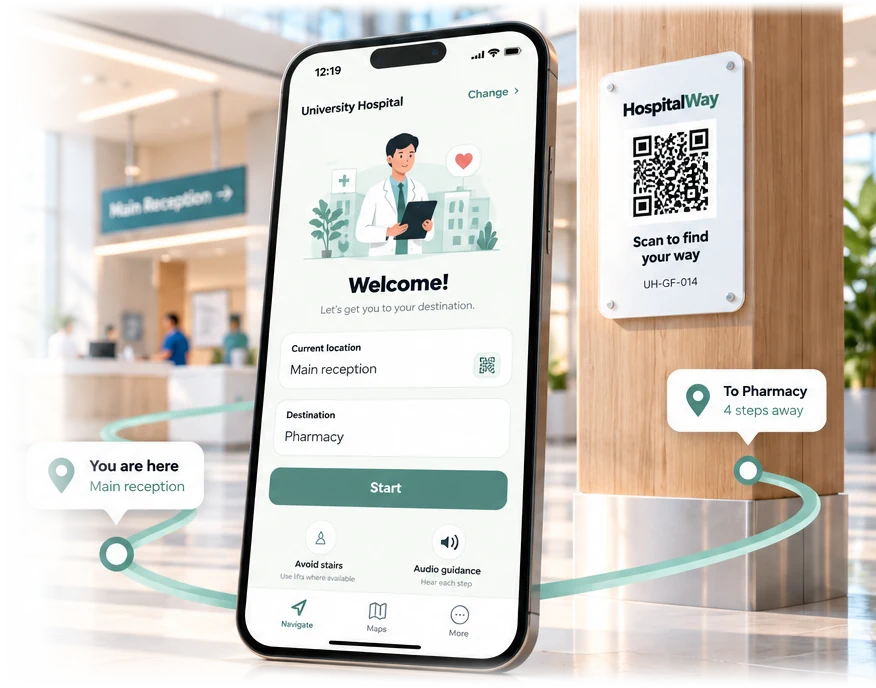
HospitalWay does not need to calculate a visitor's live indoor coordinates. Instead, it guides from one known checkpoint to the next through a validated network of predefined connections.
This avoids the need to install and maintain a positioning layer simply to deliver the core route experience. QR checkpoints can provide a simple way to establish a known starting point, while the navigation itself runs through the browser with an optional app experience for repeat users.
- No GPS-based indoor positioning.
- No Bluetooth beacon network required for core navigation.
- No Wi-Fi positioning required for core navigation.
- No account required for the browser-first visitor journey.
Implementation is more than installing an app
A hospital wayfinding deployment depends on the quality of the underlying mapping. HospitalWay is therefore positioned as a managed service that can cover the work needed to create and maintain that digital model.
A typical implementation discussion can include site surveying, checkpoint and destination definition, directional photography, network configuration, route validation, QR checkpoint planning and the process for keeping routes current after launch.
The exact rollout, support model, accessibility requirements and local technical review would be agreed with the healthcare organisation for the site in question.
A focused starting point for evaluation
HospitalWay is currently presented through a fictional University Hospital demonstration so healthcare organisations can evaluate the concept without implying deployment or endorsement by an NHS body.
A demonstration can focus on the parts most relevant to a Trust or healthcare organisation, including the visitor journey, the route model, implementation approach, data handling, maintenance and how an initial hospital area could be scoped.