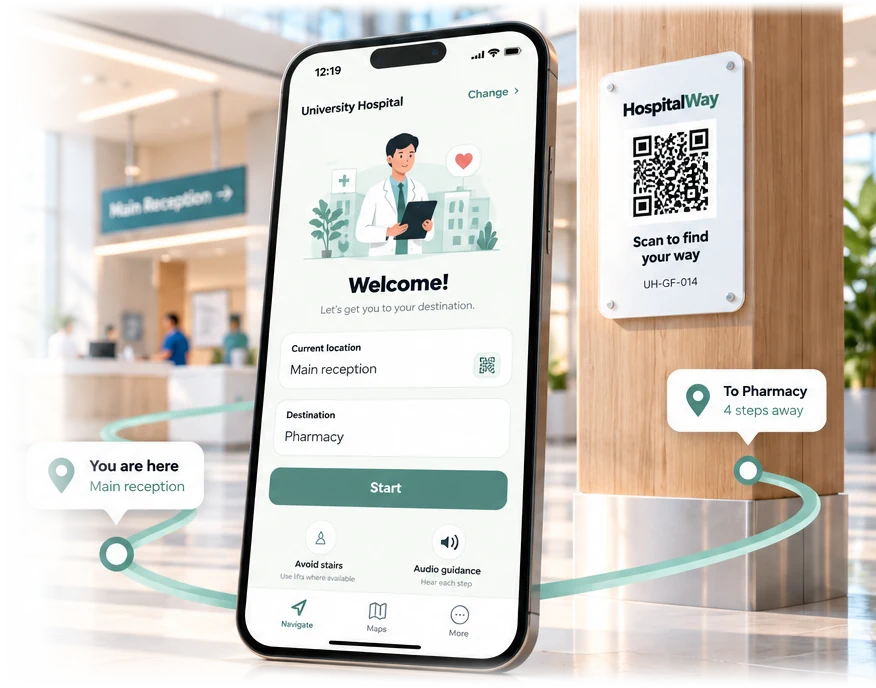
What hospital wayfinding needs to solve
Hospitals are difficult places to navigate because a single journey can cross entrances, reception areas, long corridors, junctions, lifts, stairs and departments that look very similar. Static signs remain important, but they cannot always explain the whole journey from one part of a site to another.
HospitalWay is designed to sit alongside the physical environment and provide a clear digital route from a known starting point to a selected destination. Instead of asking the user to interpret a floor plan, it breaks the journey into simple movements that match the building around them.
Guidance that matches the view in front of the user
A key part of HospitalWay is direction-dependent imagery. A checkpoint can look completely different depending on which corridor the user arrived from, so the system can associate different photographs with different approaches to the same location.
That means an instruction such as turning left towards the lifts can be paired with the view the visitor should actually be seeing at that moment. The aim is to reduce the uncertainty that appears when a generic arrow or map does not match the physical space in front of the user.
- Short, physical instructions such as left, right, straight ahead and enter.
- Photographs captured from the direction the user is approaching.
- Landmarks used selectively when they make the next movement easier to recognise.
A connected digital model instead of continuous tracking
HospitalWay represents the hospital as checkpoints, destinations, landmarks and the real connections between them. Each connection describes one movement that a person can actually make inside the building.
Routes are calculated across that predefined network. Because the system starts from a known checkpoint and guides the user to the next known checkpoint, it does not need GPS, Bluetooth beacons or Wi-Fi positioning to estimate where somebody is moving in real time.
This also makes the route logic explainable. Direct connections are only created where locations are physically adjacent, while longer journeys pass through the intermediate corridors, junctions and vertical connections that a visitor genuinely encounters.
Wayfinding that stays current as the hospital changes
Hospital wayfinding is not a one-off map. Departments move, corridors are reconfigured, entrances change and signage evolves. HospitalWay is therefore designed as an end-to-end service rather than only a navigation interface.
The implementation can include surveying the hospital, identifying checkpoints and destinations, capturing directional imagery, configuring and validating routes, supporting QR checkpoint rollout and maintaining the digital model as the site changes.
- Survey and map the real hospital environment.
- Validate routes before launch.
- Update checkpoints, imagery and route logic when the building changes.